Glimpses into Quantum Transformation: a brief story of what happened at FAIDA 2 Conference (2025) and insights into FAIDA 3 Conference (2026)
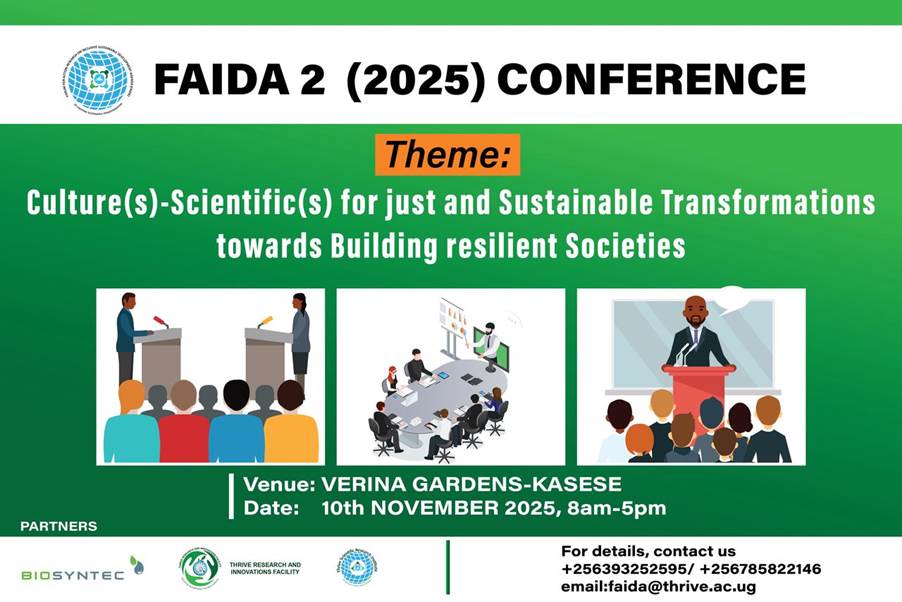
ON WORLD SCIENCE DAY, 10 November 2025, a remarkable event took place: the FAIDA 2 Conference. FAIDA stands for Forum for Action-Research on the Inclusive-Sustainable Development Agenda (FAIDA). The FAIDA program represents a remarkable and exciting development in African science and technology. FAIDA Conferences and their preparatory events bring together various stakeholders—not just for groundbreaking research and science, but also to inspire innovation and education that foster sustainable progress iteratively. What makes these events especially meaningful is their roots in community action research and community-engaged improvement, which create a warm, collaborative environment for all involved.
2021-2022 was a period of designing and planning the FAIDA program. The first FAIDA events took place in 2023 with the inaugural FAIDA Conference on December 8, 2023, at the Kasese Municipal Hall in the beautiful Rwenzori Mountains Region (Rwenzoris). This article is an exciting summary of what transpired during the second event (i.e., the FAIDA 2 Conference), which took place on World Science Day 2025 (November 10) at Virina Gardens. It also offers a sneak peek of what is coming at the third event in 2026, i.e., FAIDA 3, after drawing lessons from the FAIDA 1 and FAIDA 2 Conferences.
1. From FAIDA 1 to FAIDA 2
Before diving into FAIDA 2, let’s take a quick moment to revisit FAIDA 1. This initial focus was on exploring culture, agricultural livelihoods, and sustainable development. True to the spirit of the original FAIDA Conferences, FAIDA 1 brought together three critical groups: the Next-Generation Scholars (like primary and secondary students), the Current Generation Scholars (researchers or scientists presenting scientific papers), and practitioners and policymakers who interacted with both groups. A thoughtful critique raised some crucial questions, especially about how well current scholars and academia, in general, are practically and culturally integrated, particularly in sustainable agriculture. For example, there was curiosity about why some agricultural teachers are seen buying food at markets. Another point of discussion was the activism among scientists, especially around promoting sustainable agriculture rooted in cultural practices. A highlight that really engaged participants was a presentation on climbing beans, illustrating how they blend cultural traditions with nature conservation. In the local dialects of the Rwenzoris, this bean is called omudaluku or omusambalhuka. The lessons from FAIDA 1 reveal the heart of the conference and suggest pathways for community-based research and action that bridge science and local knowledge to tackle complex issues. An academic article about this conference is currently in development and will be published in SIDS, volume 1, by Springer Nature. Plus, there’s a video capturing a key excerpt from the event, which you can check out here.
2. FAIDA 2 (2025): how it was organized and what transpired right from the opening plenary
First and foremost, the event began with a plenary featuring a general overview of FAIDA, followed by FAIDA 1 and the steps taken to ensure the FAIDA 2 Conference was a success: a dedicated organising committee was formed to manage the event. A passionate editorial team was also established to review academic submissions, especially manuscripts for presentation, carefully. Additionally, another team was responsible for preparing engaging activities, including exciting debate championships for both primary and secondary schools, thanks to the relentless dedication of Mr Elvin Praise Mumbere, a very enthusiastic academic assistant at the THRIVE Facility. Progress was celebrated and reviewed weekly during lively meetings starting in July 2025, leading up to the fantastic run-in events and culminating in the memorable confidence session day.
Two exciting events were planned: the debate and the MDD championships. Although time was tight and the MDD couldn’t be held, the debate championship went ahead with enthusiasm. It was hosted at the multipurpose hall for the secondary schools and at Rwenzori International University for the primary schools. Many passionate debate teams from schools across the region participated, and those who made it to the semi-finals were preparing for the thrilling finals. In the primary category, teams from Nadir Preparatory and Kamaiba Primary showcased their skills, while in the secondary category, the semi-finalists who advanced to the finals included Standard High School, Nyamwamba, and St. Theresa Girls Secondary School, Nsenyi. These debates by these schools (primary and secondary) formed the first curtain event of the FAIDA 2, in line with the FAIDA format.
2.1 The curtain-raising debate: the views of the Next Generation Scholars
These wonderful primary and secondary school teams started the conference with lively debates. In the spirit of the FAIDA Conference, they are affectionately called Next Generation Scholars, key participants in the first chapter of the event. Their ideas and viewpoints are highly valued because they are the scientists of the future, who should understand—or at least get a glimpse of—how to transform society positively with innovative scientific knowledge. At the conference, they also have the great opportunity to connect with what FAIDA describes as Current Generation Scholars or Scientists. Here, they receive early mentorship on the scientific process, especially through active engagement with scientific presentations. The Current Generation Scholars and their impressive work make up the second chapter of the FAIDA Conferences. At this point, one of the many things that is clear is that FAIDA Conferences serve as a platform for showcasing scientific innovation and mentoring emerging and future scientific innovators.
More specific to FAIDA 2, the Next Generation Scholars debated the resolution: “This house believes that integrating science and culture is vital for sustainable development in emerging economies.” They were judged by a team of three: two experienced debate judges (Ms. Christine Nanfuka and Mr. Bright Beyongyera) and one scientist (Doreen Atwongyeire). Notably, the FAIDA Debate aims to mentor future scientists and organic intellectuals who will help transform society. By giving them the opening session, the Next Generation Scholars are allowed to shape the tone in the conference, airing critical matters of interest. In the case of the FAIDA 2 Conference, the views from the debate highlight the central need for inclusivity and unity in diversity in the context of co-existence culture, as well as for indigenous or local knowledge to be integrated with science in transforming society. Excerpts of their version views can be accessed at the THRAIF TV.
2.2 Current Generation Scholars: progress and cases of just sustainable transitions
In line with this overtone from the debate, the Current Generation Scholars shared their exciting research related to the theme. They were thoughtfully arranged so that, during a keynote speech, the first speaker could give feedback on the debate section by the primary and secondary school students, i.e., the Next Generation Scholars. This included a fascinating presentation on The Role of Culture in Science Education, delivered by Professor Moses Muhumuza from Mountains of the Moon University. One thing to note is that Professor Muhumuza stole the show with an aspect of quantum transformation, illustrating how in the quantum realm, culture, spirituality, and science meet and how this influences society. The interest of several conference participants in this topic has led to a specific subtheme for the next, third FAIDA Conference in 2026.
After Professor Muhumuza, five additional presentations were delivered by Current Generation Scholars. These included Ms. Doreen Atwongyeire (with Dr. Dorothy Birungi Namuyiga as the main discussant), Dr. John Sekajugo (Mountains of the Moon University, presenting a project: B-SaFFeR), Ms. Edwiger Naijjuka Ampurire (a doctoral student at Uganda Martyrs University and member of the ENS Research Group), Dr. Christopher Mukididi (a priest and senior academic executive at Uganda Martyrs University), and Mr. Dickson Pius Mdugala (an MPhil/PhD student in Interdisciplinary Social Studies at Makerere Institute of Social Research, Makerere University). While the details of the presentations will be included in the detailed, more academic-style report, here is a brief overview of what they involve: Primarily, they are a diverse set of presentations centred on the theme:
Atwongyeire presented a study on “Understanding Riparian Land Use and Land Cover Change in River Catchments: Integrating Spatial-Temporal Data with Local and Indigenous Knowledge, a Case Study of Rwizi, Uganda.” This research aims to develop new knowledge on the added value of integrative science and indigenous knowledge in sustainably managing natural resources. Related to this is the presentation by Sekajugo of a research project called B-SaFFeR. B-SaFFeR stands for Building Socio-ecological resilience of communities to Flash Flooding in the Rwenzori Mountains. The research strands in the project aim to inform the development of two main items. First, a model for flash flooding in the Rwenzori Mountains; second, a community-based insurance scheme against natural hazards. Both of these outputs would apply to other contexts facing climate-related crises, such as those caused by flash floods. According to the presenter, two doctoral studies are crucial to developing the knowledge base for these two models: Alex Moruleng and Victo Nabunya, both of whom are registered and have started doctoral studies at Vrije Universiteit Brussel and KU Leuven, respectively. The two students were present, and it was highlighted that they have already started interacting with communities in Kasese, where they are collecting data and where the project is being implemented within the context of the two project research strands. Additionally, the project is training farmers in disaster risk reduction and financial literacy to build socio-ecological resilience further. Join For Water (represented at FAIDA 2 by George Bwambale) and THRIVE Facility (represented by Gloria Kabugho) are key project partners in training and community linking.
The presentation by Ampurire brings Atwongyeire and Sekajugo into a special hybrid spotlight structured around the agroecological approach: Agroecology for Climate-Resilient Avocado Agri-Food Systems. Presented as a draft doctoral research proposal, the study aims to deploy agroecology as a penance to the biophysical and socio-economic challenges affecting farmers in the Rwenzori and beyond. While economically viable, the avocado agri-food system continues to be challenged by biophysical hazards such as soil erosion and landslides. Given that it is still practiced mainly as monocrops, eternal inputs (such as fertilizers and pesticides) due to reduced soil fertility would further complicate the situation while driving degradation, among others. Agroecology, if tested and found to be a panacea, would not only boost the avocado agri-food system but also serve as a mitigative measure against climate and natural hazards in the regions, especially by further supporting soil and ecological stabilization in hilly and riverbank areas along recurrently flooding rivers. To better incorporate culture, this study could feature indigenous agroecological approaches, including those used in the Farmer Family Learning Group (FFLG) approach.
From the biophysical studies (Atwongyeire, Sekajugo, and Ampurire) came the social studies, a core element of the sustainable development agenda. For instance, Mukidi presented a study titled “Ezekiel and Cultural Resilience in Exile: Prophetic Insights for Sustainable Development and Global Renewal.” This study on Ezekiel highlights justice, responsibility, and sacredness, offering hope to displaced communities. It links ancient wisdom with modern ethics to foster moral, spiritual, and social growth, supporting UN SDGs, especially in rebuilding resilience amid displacement caused by climate and ecological hazards. Closer to this was the paper presented by Mdugala. The paper critiques colonialist, Christian-centered marriage practices in Neo-Liberal Tanzania, referencing Sitwala Imenda’s Unmarried Wife Novel. It highlights their harmful effects on women and children, advocating for decolonizing this oppressive religious system that opposes inclusivity and other relational approaches in Africa. The paper argues that colonialist methods threaten social change, especially prejudiced language that excludes non-conformists. This, in the concluding plenary, was taken as a core challenge for the modern university, with a brief on the role of culture in higher education by Professor Nathaniel Walemba of Rwenzori International University. A full presentation on this topic is expected at the FAIDA 3 Conference: how should the university be rethought to incorporate culture, or, more specifically, to FAIDA 3, to incorporate culturally sensitive self-reliance, as well as produce graduates that will drive socio-ecological resilience and transformative change?
2.3 The closing plenary: announcement and award ceremonies
The concluding plenary was a memorable highlight of the FAIDA 2 Conference. It was a special moment to celebrate and announce the final winners of the FAIDA 2 Debate Championship. Keep in mind, this assessment is part of our effort to support and nurture the promising scientists of tomorrow, guiding them in the world of scientific research.
Awards included trophies, medals, and prizes, all given to the top debaters, debating teams, and the winning schools, whether primary or secondary. All finalists from the four schools—St. Theresa Girls’ Secondary School, Nsenyi; Standard High School, Nyamwamba; Kamaiba Primary School; and Nadir Preparatory School—also received medals:
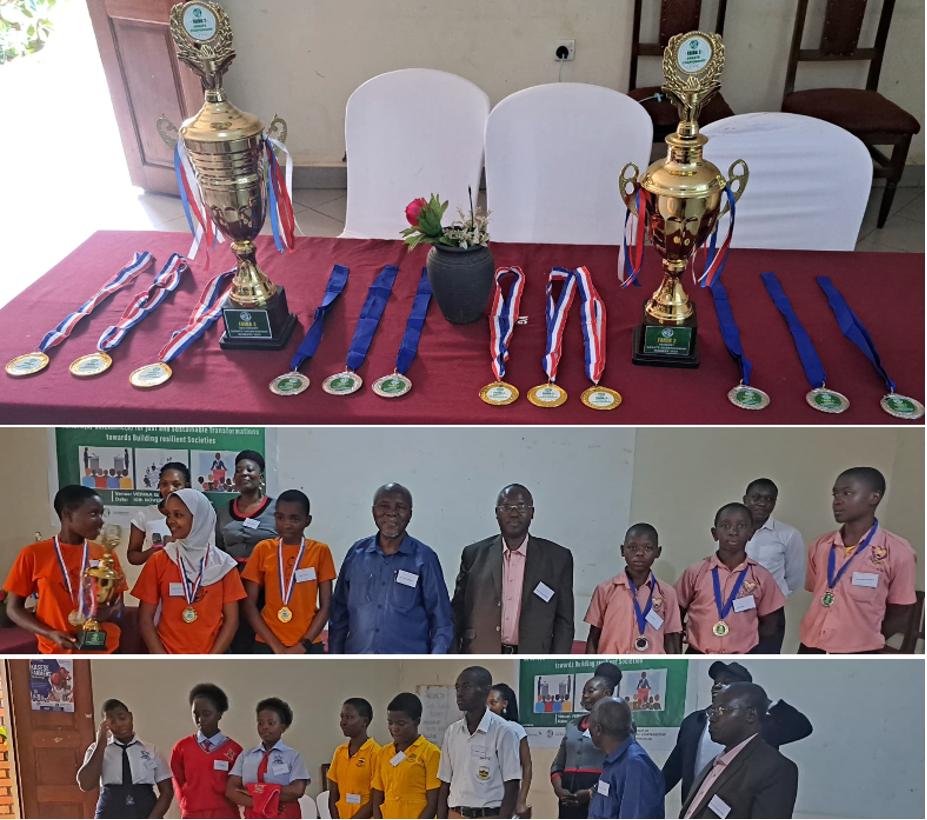
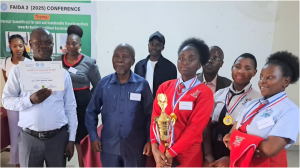 Congratulations to St. Theresa Girls Secondary School, Nsenyi, on their fantastic win! A heartfelt thank you to the Patron, Mr. Seth Herbert Kule, for his wonderful coaching and guidance that helped lead the team to victory. Special applause also goes to the impressive finalist debaters from Theresa Girls Secondary School: Ms. Rovine Chinese Biira, Ms. Aidah Kabundama, and Ms. Laticia Consolate Muhindo. Just a friendly reminder—since the trophy needs to be won three times to become permanently owned, St. Theresa Girls Secondary School still has two more wins to go! That means Mr. Seth Herbert Kule and his dedicated team of mentors have a special mission: to aim for at least one winning team at the next two debate championships. Keep your spirits high—they’re within reach!
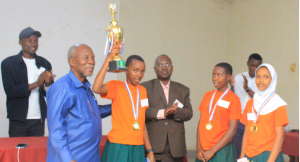 Nadir Preparatory School took the primary school trophy. We hope they will win two more times to keep the trophies. Much more congratulations go to the Patron, Mr. Jamal Lhukando, for coaching and mentoring this winning team. The (Nadir Preparatory School) team, comprising Ms. Trinah Atwine, Ms. Daphine Muhindo, and Ms. Nusurah Umar Aikyiriize, as shown in the picture. Ms Trinah Atwine (holding the Trophy in the picture above) of Nadir Preparatory School and Ms Elvine Musoki of Standard High School received the best debater prizes at the FAIDA Debate Championship, each receiving UGX 750,000. We wish them the best in their studies and hope they will win more in the subsequent FAIDA Debate Championships (FAIDA 3, 2026). With more support coming in, the program looks forward to supporting an increasing number of excelling students.
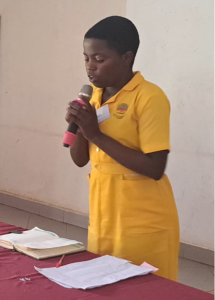
A special aspect here warrants mention and attention: Musoki’s case caught the attention of the various participants, as after seeing her shed tears upon being announced the winner, they prompted a deep dive into her life. It was realised that this high school science student has been struggling with fees for a long time. The final term fees for 2025 were not finalized. Some participants were touched and contributed UGX 300,000 toward her fees, in addition to contributing to top up her 2026 fees when she’ll be in her last year of high school. A complete story about her is in the offing. Thank you for your kind support. Suppose you are interested in supporting her education. The THRIVE EDUCARE Program is specifically taking charge of this. This is an indicator of how the FAIDA events can go beyond being an academic event into philosophy, while also supporting the sharing of new knowledge, generating new research ideas, co-creating innovations, and enabling networking among like-minded people, among other things.
SUMMING UP, it is a pleasure that the FAIDA 2 Conference took place, demonstrating the continuity of this remarkable event, thanks to the kind efforts of the various teams that made it possible. As at FAIDA 1, incorporating views and insights across age groups remains a crucial part of inclusivity. Within that, there is a special focus on younger stars and young people, as previously noted as Next Generation Scholars. They are considered to be the leaders of today and future scientific innovations for transformative change. One can ask why. The answer is: if they must produce appropriately scientific innovations for tomorrow or in the future, they must have the logic to do it today. As such, they should be engaged in imagining and working toward the world they would be. The FAIDA program would like its voice to challenge or critique what is being done by those in the afternoon and evenings today. Why should this be? There are challenges facing the world today that result from improper actions taken yesterday, but this burden is thus transferred. It is our assumption, therefore, that by incorporating the views of younger and youth, an appropriate world for them can be co-created with and for them. We believe that involving them can prevent or mitigate inappropriate consequences and help inform decision-making. Another key focus noted next is on the ecological, economic, and social aspects of sustainability, thereby closing the loop: inclusion in the sustainable development agenda. The entire focus is on research, science, and innovation, while bringing together various stakeholders to co-create actionable interventions. This approach requires a multistakeholder research approach, transitioning from individual epistemology (sometimes referred to as the modern ontology) to a transdisciplinary one that extends beyond a single discipline to create a hybrid of voices from multiple or varied entities, including humans and nonhumans. Moreover, iteratively, from one FAIDA to the next, new ideas are co-produced, new innovations co-created, and new research questions raised.
While the approach is still emerging, that is the overall target vision. We gather all views and refine them into a scholarly paper, then publish it to share with the whole world and be part of the knowledge that is continuously shaping it interactively. Related to that, from one event to the next, specific aspects that steal the show are showcased in the publication or innovations that should be taken into practice and can inform the next theme or subthemes. What caught attention in FAIDA 1 was climbing beans, and various participants expressed interest in going and starting to practice agroecological production of them. In FAIAD 2, the show was stolen by the presentation on quantum transformation. Many participants expressed interest in learning more about it and in how to start incorporating it into their everyday lives to influence meaningful social transformation. As such, a sub-theme has been dedicated to it in FAIDA 3.
Why must one not miss participating in the FAIDA Conferences, more specifically, FAIDA 3? There are several benefits, just to name a few:
- The opportunity to gain new knowledge that shapes the world. A state-of-the-art is presented along with scientific presentations in the special context of the theme. This includes a chance to interact with scientists contributing to that body of knowledge.
- Participating in contributing to new research ideas that create new knowledge to shape the world and our society better. At FAIDA, new knowledge is shared, innovative actions are co-created, and new research ideas and questions are born.
- Creating new networks and connections worldwide, focusing on contributing to shaping the global agenda. Our publications are trans-local while influencing local transformations.
- FAIDA events go beyond being academic gatherings by offering various ways to secure funding and by showcasing innovative ideas and excellence to resource mobilization collaborators. Similarly, talented students receive support through bursaries, scholarships, grants, or prizes for their studies.
- FAIDA is a science and innovation platform. You gain insights into how to improve: it is your platform to showcase our innovations to like-minded scientists, researchers, innovators, and other related stakeholders.
- Opportunity to publish in Web of Science-indexed outlets: We publish a volume called ‘Sustainability and Inclusive Development Reviews’ (SIDs) with Springer Nature. We also collaborate with other scholarly journals, giving each presentation a chance to be published. Additionally, we produce a book, conference proceedings, and a science and innovations newsletter.
So, please do not miss our next FAIDA, i.e., FAIDA 3. In general, FAIDA 3 will be the second in a series exploring how integrating science (not modern science) and culture can transform our society in meaningful and impactful ways. While remaining diverse, the core focus of FAIDA 3 will be on Education for Self-Reliance, Bioeconomy, One Health, and Quantum Transformation through the lens of sustainability, exploring how integrating science with culture can foster an appropriate approach to these aspects. For More info about FAIDA 3, follow the link here.
Acknowledgements: The FAIDA 2 Conference (2025) was only possible due to the kind financial and in-kind support from various institutions, in the first place THRAIF and, more specifically, the DOBOLE Academic Program, which supports the scholarship. Second, THRAIF for hosting and supporting the FAIDA secretariat; and Biosyntec Uganda: Thank you, Biosyntec Uganda, for joining to support this program. By doing so, you are making a significant contribution to the generation and sharing of innovative knowledge, as well as to mentoring scholars who will transform our society. Thank you very much to all funders and supporters, and we hope you receive more resources and maintain the same spirit of kindness towards our forthcoming events, especially FAIDA 3, 2026. The ENS Research Group, although it came on the eve of the event, did great wonders to ensure a smooth event, more specifically thanks to: Doreen and Charity Akao (who formed the rapporteur team), Mr. Lazarous Bwambale and Ms. Edwiger Naijjuka Ampurire (who formed the moderating team), Ms. Eseza Muhindo Muthahwa (who joined Janet Nderu at the reception), and Mr. Blasio Bisereko Bwambale, who joined the technical team. Thanks to Virina Gardens for the hotel services.