Program Vision
To promote evidence-based economic sovereignty and ensure insurance against any hazards that confront communities.
Program mission
To co-create, co-design, co-develop, support, and monitor strategies that support all possible means of fostering social enterprises, sustainable income-generating activities, and other sustainable ways of creating a community-based insurance against any hazards while improving livelihoods.
About
The Community Livelihood Improvement Groups & Unions at THRAIF constitute a program that has evolved from the self-help initiative. This program, commonly referred to as livelihood improvement, has been one of our core endeavors since its inception. It operates as a living lab network where we engage in community-driven action research and iteratively develop livelihood innovations. While formulating new research questions, we leverage the knowledge and skills cultivated in two key areas:
innovative scientific research and innovative training and education in community livelihood improvement. Rather than serving as an end, the findings and existing knowledge on sustainable communities act as a starting point for further iterative research questions and innovations, establishing a foundation for continuous improvements in community livelihood. The process begins with a Community Livelihood Improvement Group (COLIG), followed by the formation of the Community Livelihood Improvement Union (CLUN) after achieving successful progress in production transitions to corporate ventures.
Genesis, Evolution, and Objects
Initiated in 2019, the program primarily functions within groups formed under the auspices of COLIGS. In 2024, the aspect of unions was introduced to facilitate progress beyond the group level into a union. In alternative contexts, COLIGS are referred to as VSLAs (Village Savings and Lending Associations) or SILC (Savings and Internal Lending Communities).
Yet, the lessons learned from our experience indicate that these groups save money, provide credit, and engage in various activities while co-creating knowledge and innovative practices to enhance their livelihoods and secure their welfare. Even if a particular group is not actively pursuing this, it remains oriented toward those objectives. Within these groups, we embrace the philosophy of empowering individuals to help themselves, based on collaboratively developed knowledge. This is evident at the union level, where they can foster more collaborative corporate activities. In line with this, we assert that sustainable excellence requires adopting well-reasoned lifestyles that honor local and indigenous values and practices while being inclusive of diverse efforts.
Program objectives
In line with the above, we have refined our objective to create knowledge-based, economically sovereign communities. Specifically, we have (but are not limited to) the following specific objectives:
- Establish, assess, and adopt existing financial community and/or institutional structures for economic empowerment.
- Strengthen the capacity of established and adopted social enterprises (linked to the entrepreneurship centre) as income-generating activities.
- Strengthen networking and partnerships within existing structures.
- Conduct periodic reviews of the livelihood program activities. This includes the research and monitoring to bolster the functional aspects.
- Ultimately establish, monitor, and support community-based finance platforms to secure savings against risk, while
promoting sustainable economic and business empowerment excellence (incl. establishing a community-based instance scheme against any societal or biophysical hazard confronting societies). This also includes support to community saving groups to function as a community-based village banking system.
COLIGs in communities
We reach out to various people (incl. women, youth, and men) who have attained maturity. We assume that at that stage, they have the intellectual aptitude to participate actively in the co-creation of knowledge and action. Still, they also have economic sources, at least a source of income, from which they can afford to save a certain amount regularly.
They join an existing COLIGS or become initiators of one, including selecting the social enterprise and the group’s name. The name, in most cases, reflects the nature of the CORE social enterprise and the central vision or mission of the COLIG.
Next to this are those conditions needed:
- Age bracket
- Common locality
- Common/Related enterprises
- Commonality of interest
When groups grow into unions
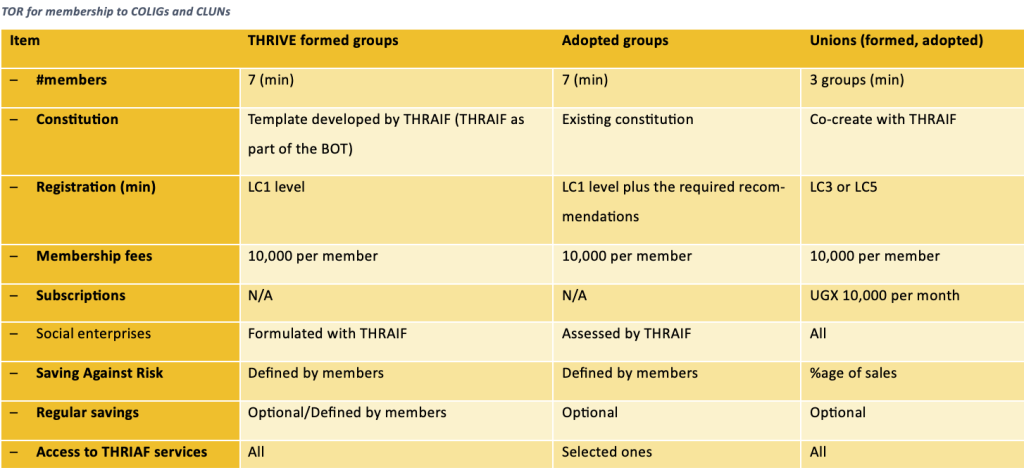
At the state of a union, the various COLIGS are recognized to have reached a level of maturity: they can perform more legally organized tasks. Here, they operate like any formal cooperative. At this level, we support them in developing high-level corporate businesses, including, for instance, functional small and medium-sized industrial processing plants.
A formal functional office is organized to ensure that they are more semi-autonomous and engaging at the corporate level. At this stage, they become a CLUN. The money-saving aspect of savings against risk is expected to be implemented at the level of a CLUN, enabling the enterprise(s) to operate accordingly.
Then, savings against risks are no longer obtained directly from the members’ pockets but rather as deductions from business earnings. Instead of savings against risk, members still contribute corporately in the form of a subscription to the union, whose secretariat is hosted at THRAIF.
Benefits of COLIGS and unions from THRAIF
Capacity building in various aspects of livelihood improvement. THRAIF will conduct regular informative training sessions and extension services to enable CLOGs and CLUNs to perform better than ever before, enabling them to boost production. These include training and extension services on such areas as sustainable production and the required skills in Financial literacy training, which encompasses saving and lending, proper financial record-keeping,
and statutory registration, among others. Implied within this sphere are activities such as exposure visits to foster co-learning.
- Lobbying and fundraising for COLIGs and CLUNs, writing proposals, and networking with government structures that support development. COLIGs and CLUNs are at the heart of our efforts in each of our projects and in any support we receive. This support is in various areas, including aid to boost enterprises. This includes being beneficiaries of the field-based trials conducted as part of our research projects.
In line with lobbying and fundraising is the aspect of networking with other THRAIF partners: each of the established and adopted groups and unitions shall have the opportunity to interact and benefit from our partner services for as
long as they have fulfilled all the set rules and obligations.
- Access to crucial services for sustainable excellence: All members of a COLIG or CLUNs shall have access to all THRAIF services, including EDUCARE, Financial Services, Livelihoods, Health, and Environmental management, among others. This also includes mobilizing assistance or relief to the COLIGs during times of disaster. This assistance will depend on the SAR (Savings Against Risk) and/or SYE (Save as You Earn) amount that a COLIG has with THRAIF.
- Recipients of benefits from the Research and monitoring activities of THRAIF. This includes results aimed at boosting Sustainable production and productivity, as well as green processing and markets for local communities.