THRIVE EDUCARE Program (TREP).
Program Vision
To promote societal enlightenment with science-based and lifelong skills for sustainable excellence.
Program Mission
To develop and implement innovations that ensure learners at any level of education have access to quality education, remain in their institutions, and build capacities that enhance their competitive advantage in securing employment or creating jobs.
Object, genesis, and rationale of TREP
Under the innovative training and education faculty, TREP arises from co-creating methods to secure sustainable skills for excellence. The program’s initiation aimed to address the need for consolidating strategies to develop resilient livelihoods in the households of all members and others connected to THRIVE. In this context, TREP serves as a service and an operational program, enabling us to learn from one cohort of learners to the next about the best ways to finance innovative education.
Moreover, we also utilize the TREP platform to collaboratively think with educational institutions about how to make teaching and learning transformative, creative, and sustainable regarding skill development. This includes research and action on scholarly materials and innovative teaching methods to cultivate a culture of learners who foster excellence in their communities upon graduation. This program aims to provide fees for children and educational materials that enable them to succeed in school; it also involves a systematic analysis of the overall transformative social change needed to drive sustainable excellence, including employability or job creation.
Practicalities on the source of funds
How does this program operate? How do we pay for the funding for the learners under this program? How do we get scholastic materials for those learners?
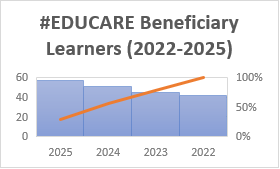
First, how the program operates: THRAIF, under the THRIVE Educare Program, pays school or tuition fees for learners on behalf of their parents or guardians for the agreed-upon period, ensuring that learners remain in school. An MOU is then drawn up with their educational institutions to facilitate fee payments. Typically, the payment of fees is settled at once per unit segment outlined in the MOU. Parents repay in small amounts at a modest charge to cover the administrative and professional costs incurred during operation, within an appropriate timeframe.
Second, how do we get the funds and other materials under this program? One source of our funding for the program is the savings scheme. This scheme dates back to the establishment of THRAIF, where action research was conducted and a unique savings plan was developed. It is known as Savings Against Risk (SAR). The SAR scheme generates part of our funding. Groups under THRAIF manage the SAR schemes.
It is important to note that most members and others we engage with are not financially well-off. Some are highly vulnerable and marginalized. This is why we aim to develop a system where these funds can be provided as soft loans and a revolving fund for these members as we expand this program.
Thanks to the DOBOLE Scholarship established in 2025, secure funding for supporting and studying innovation research and education is taking shape. However, more is still needed. Therefore, any donor support for this vital educational research funding is greatly appreciated. Additionally, other donations to support these missions are welcome. This could include providing specific scholarship materials or equipment, which would significantly help many parents or guardians who struggle to acquire educational materials while attempting to pay back.
Our (inter-)disciplinary and decolonial focus
We focus on all subjects to support lower education, from kindergarten to lower secondary. From high school through higher education (including university), we are interested in research-based support for teaching and learning crucial subjects such as STEM (Science, Technology, Engineering, and Mathematics). We consider these essential for transformative change. We are also aware of the non-STEM subjects that promote transformative social change. In this context, we rolled out a constituent program: the INTRAL (Innovative Transformative Research and Learning) program, housed at the THRIVE Training and Education Centre (TREC).
INTRAL seeks to decolonize teaching and learning by being context-specific, incorporating local, indigenous knowledge, and essential employable skills. The program fosters research-based education to produce graduates who will transform communities.
For more information about this program, please visit the TREC webpage.
How to become a beneficiary or get involved
For learners from kindergarten to high school to benefit from this arrangement, their parents or guardians should be members of one of the COLIGS (Community Livelihood Improvement Group Schemes) under THRAIF. That is only in the context of EDUCARE support. Others include contexts requiring a grant, such as a bursary or scholarship, based on ascertained need or intellectual excellence, yet from an economically vulnerable background. This is assessed on strict criteria. We currently run an academic grants program called DOBOLE Academic Grants (DAGs). To benefit from this program, applicants must be academically outstanding but financially vulnerable and willing to contribute to the same program after completing their studies. A formal application must be submitted online (here). This formal application is preceded by an expression of interest sent to the DAGs program via email (trec@thrive.ac.ug) to the academic coordinator, copying in the operations manager (info@thrive.ac.ug). Interviews are conducted to determine whether an applicant is accepted into the program.
Higher education institutions are mainly beneficiaries of the INTRAL program. They are also beneficiaries because they are the institutions where our beneficiary learners study. Some are also partners in our related projects related to TREP or innovative training and education in general.
Supporters (funders or donors) are essential to this program. We invite you to get involved and support us. Please feel free to reach out through our Contact Us page. Or via email: guardian@thrive.ac.ug or info@thrive.ac.ug, or Tel: +256 393 252 595 +256 200 905273.